Understand what QA (Quality Assurance) is and how it can transform your business!

In an increasingly digital market, quality has stopped being a technical detail to become a matter of survival. A product that fails, freezes, or frustrates the user has a short life: the customer uninstalls it, switches to the competition, and still shares the bad experience. Ensuring quality consistently, in every delivery, is what separates companies that grow from those that fall behind.
This is where QA (Quality Assurance) comes in. More than finding defects, the quality assurance area works so that they never even reach the end user, protecting the brand's reputation and reducing costs. In this article you will understand what QA is, how it differs from quality control and testing, what the professional's role is, how the area integrates into the development cycle, and why it has become strategic for the business.
What is QA (Quality Assurance)?
Quality Assurance is a set of systematic processes that ensure a product or service meets the defined quality standards. Instead of focusing only on the final result, QA looks at the development process as a whole, checking whether each stage meets the established requirements and is aligned with the customer's expectations.
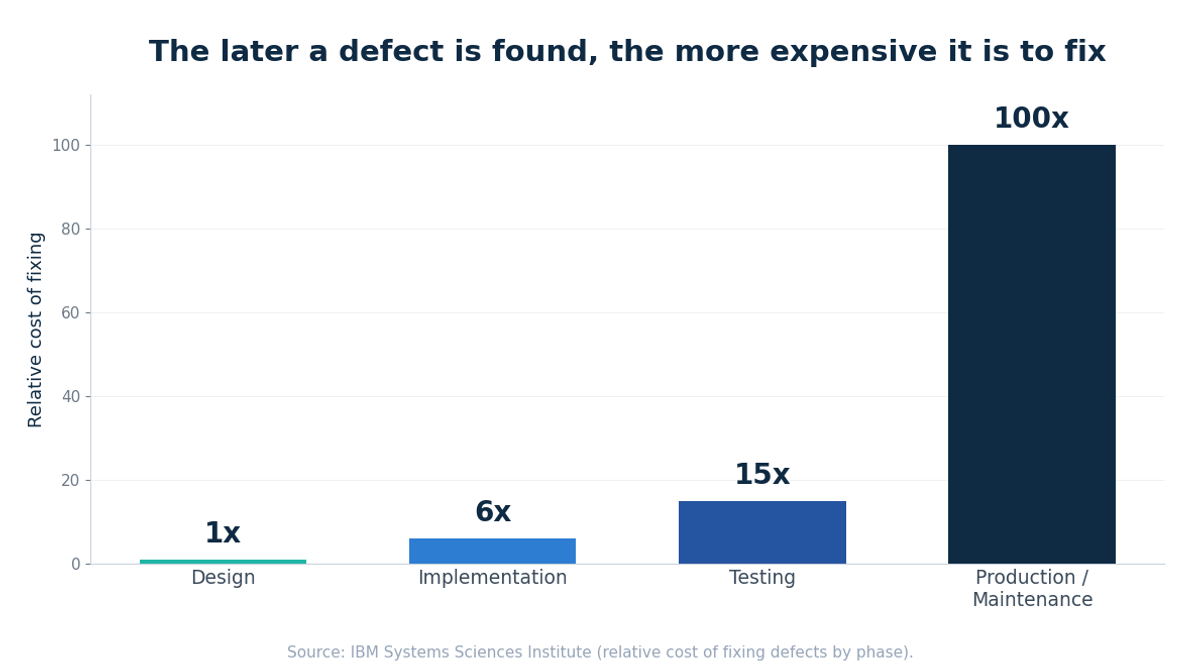
The great advantage of this approach is prevention. By identifying and fixing problems before they reach the user, QA avoids damage to image and generates direct savings: the later a defect is discovered, the more expensive it is to fix. Adjusting a system that is already in production costs much more than handling the same failure while still in the development phase.
QA, QC, and Testing: what is the difference?
Three terms are often confused, but they represent distinct and complementary things:
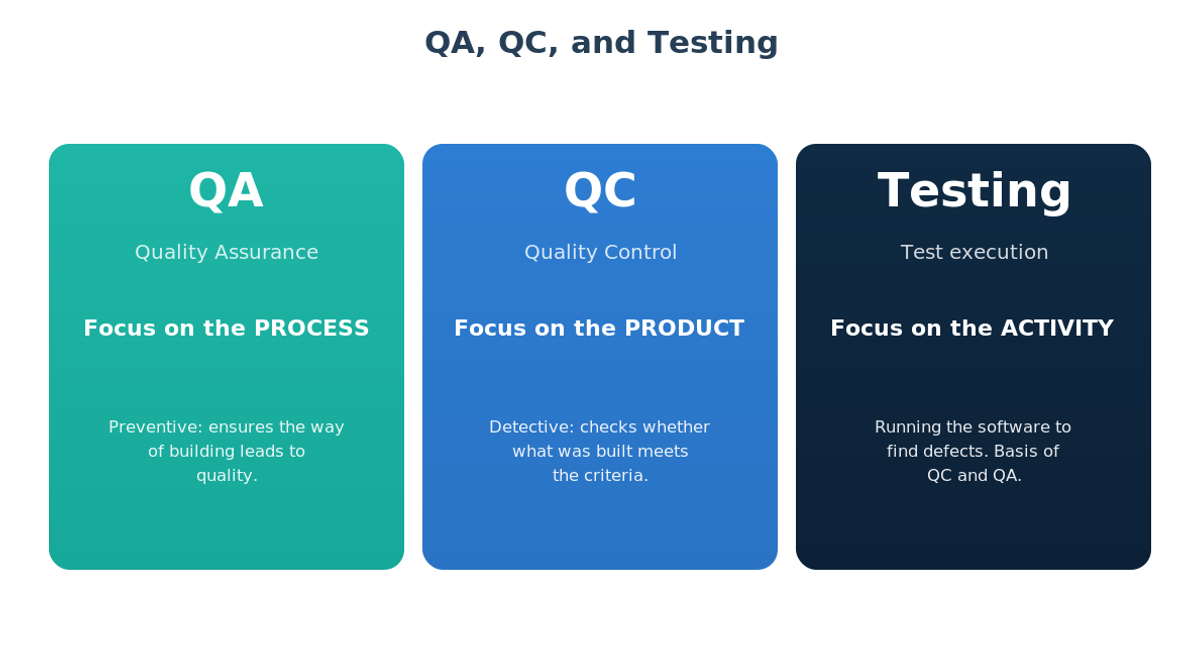
- Quality Assurance (QA): focus on the process. It is preventive and seeks to ensure that the way of building the software leads to quality from the start.
- Quality Control (QC): focus on the product. It is detective and checks, in what has already been built, whether the result meets the quality criteria.
- Testing: the concrete activity of running the software to find defects. It is one of the main tools of QC and an essential instrument of QA.
In short: QA builds quality into the process, QC checks quality in the product, and testing is the practical execution that supports both.
The role of the QA professional
The QA professional follows the entire software production pipeline, from requirements gathering to final delivery, always focused on optimizing the workflow and ensuring that the result matches what the customer expects. Their main responsibilities include:
- Defining and executing test strategies, validation techniques, and risk analyses.
- Detecting failures that could compromise the delivery before they reach production.
- Checking whether the business rules and established standards are being met.
- Identifying continuous improvement opportunities with each new version or product change.
Traits of a good QA professional
The role goes far beyond knowing how to test. The professionals who stand out combine technical and behavioral skills:
- Analytical and critical thinking to anticipate failure scenarios.
- A systemic view, seeing how each part affects the whole.
- Good communication to align expectations between technical and business areas.
- Broad technical knowledge, including manual and automated testing.
- Organization and the ability to handle multiple fronts at the same time.
QA in the development cycle: the shift-left culture
For a long time, quality was treated as the last stage, something checked only at the end of the project. That logic has changed. The approach known as shift-left proposes bringing quality practices to the beginning of the cycle, when fixing a problem is cheaper and faster. In practice, this means involving QA from the requirements gathering and integrating it into continuous integration and delivery (CI/CD), with tests running automatically on every change to the code.
This is the context in which test automation becomes QA's ally, making it possible to validate the application quickly and repeatably, without relying only on manual checks. The sooner a failure is found, the lower the cost to fix it.
This pattern is well documented: according to data from the IBM Systems Sciences Institute, fixing a defect in production can cost about 100 times more than handling it while still in the design phase, as the chart below shows.
The importance of QA in companies
With so many technological advances, countless options of apps and services appear trying to solve the same problems. The result is an increasingly demanding user who is less tolerant of failures and bugs. Without well-executed quality assurance, your product's lifespan in the customer's hands can be the same as the interval between downloading and uninstalling it.
The first impression is decisive for winning and retaining customers. That is why avoiding failures, slowness, and instability is essential to not lose users to the competition. By bringing in a QA professional or team, the company prevents these problems, ensures launches without significant failures, and protects the brand's reputation, keeping the satisfaction of those who use the product.
Main QA activities and processes
Quality assurance takes shape in a set of practices that repeat and evolve with each cycle:
- Quality planning and definition of clear acceptance criteria.
- Review of requirements and documentation to avoid ambiguities.
- Execution of manual and automated tests, according to the risk and criticality of each feature.
- Applying regression tests to ensure that new changes do not break what was already working.
- Risk analysis to prioritize where quality is most critical.
- Monitoring of metrics and continuous improvement of processes.
Metrics that show the value of QA
To demonstrate results, QA relies on indicators that make quality measurable and help direct improvements:
- Defects found before production, compared with those that escape to the user.
- Test coverage over critical features.
- Average time to detect and fix a defect.
- Defect density per feature or module.
- Cost of rework avoided through early detection.
Advantages of having QA on the team
The benefits of having quality assurance add up and directly impact the business:
- Higher product quality: deliveries that meet or exceed the customer's expectations.
- Satisfaction and loyalty: reliable products increase customer satisfaction and retention.
- Cost reduction: identifying problems early avoids expensive fixes later.
- Stronger reputation: consistency and quality reinforce the brand's image.
- Growth of the customer base: satisfied users recommend the product, expanding its reach.
- More stable revenue: loyalty sustains a predictable and growing revenue stream.
Conclusion
QA has stopped being a luxury to become an essential part of the strategy of any technology company that wants to thrive. By building quality from the earliest stages to the final delivery, the area prevents problems, raises operational efficiency, and strengthens the brand's reputation. Not by chance, it goes hand in hand with topics such as digital maturity and test automation, pillars of those who take quality seriously.
In a dynamic and competitive market, investing in quality assurance is what positions a company to grow safely. Atomic Solutions has 10 years of experience in IT consulting and has QA professionals who deliver the highest quality on the market, as shown by our success stories. Get in touch and request a quality strategy tailored to your company.
Keep reading

Test automation: what it is, how it works, why to do it, and how the right platform can optimize your business model
Understand what test automation is, when to invest in this strategy, and how it helps companies reduce failures, speed up deliveries, and scale software quality more efficiently.

SESI/SENAI SP Success Story: Quality Assurance for System Structuring and a Test Center of Excellence
Between August and October 2025, Atomic Solutions structured a Test Center of Excellence (TCoE) for SESI/SENAI SP, standardizing QA practices, reducing rework, and establishing quality as a strategic pillar in the development of the institution's internal systems.

How well-structured software architecture prevents future failures
Understand how well-structured software architecture helps reduce failures, improve performance, simplify maintenance, and prepare systems to grow with security and scalability.