What is RPA and how can it help your company?

Repetitive tasks eat up a large share of entire teams' time: copying data from one system to another, processing invoices, generating the same reports every day. They are necessary activities, but they add little and wear out whoever performs them. Robotic Process Automation, better known as RPA, emerged precisely to solve this problem.
With RPA, software robots take over these routines with speed and precision, freeing people for what truly requires human judgment. In this article you will understand what RPA is, how it works, where it differs from artificial intelligence, its real benefits, application examples, the precautions when adopting it, and how to implement the technology in your company.
What is RPA (Robotic Process Automation)?
RPA is a technology that makes it possible to create software robots, the bots, capable of simulating human actions in digital systems to perform specific tasks. These bots interact with applications and systems, manipulate data, process transactions, and respond to requests, just as a person would, but in a much faster and more precise way.
RPA is especially useful for recurring, low-value-added tasks that follow well-defined business rules. In other words, the more predictable and repetitive the process, the more it benefits from automation.
RPA, AI, and hyperautomation: what is the difference?
The terms are often mixed up, but they represent distinct layers:
- RPA: follows deterministic rules. It is excellent for structured and predictable processes, but it does not make decisions beyond what it was programmed to do.
- Artificial Intelligence: adds cognitive capability, such as interpreting texts, images, or natural language, handling less structured scenarios.
- Hyperautomation: combines RPA, AI, and process mining to automate end-to-end flows, and it is the direction the market is heading.
It is also worth not confusing RPA with test automation: while test automation validates whether a piece of software works as expected, RPA runs business processes across systems already in production.
How does RPA work?
RPA bots are configured to reproduce a person's actions in one or more systems, following a defined step by step. Among the most common tasks are:
- Data entry and validation in systems.
- Processing of invoices and receipts.
- Report generation.
- Responding to standardized emails and requests.
- Data transfer between different systems.
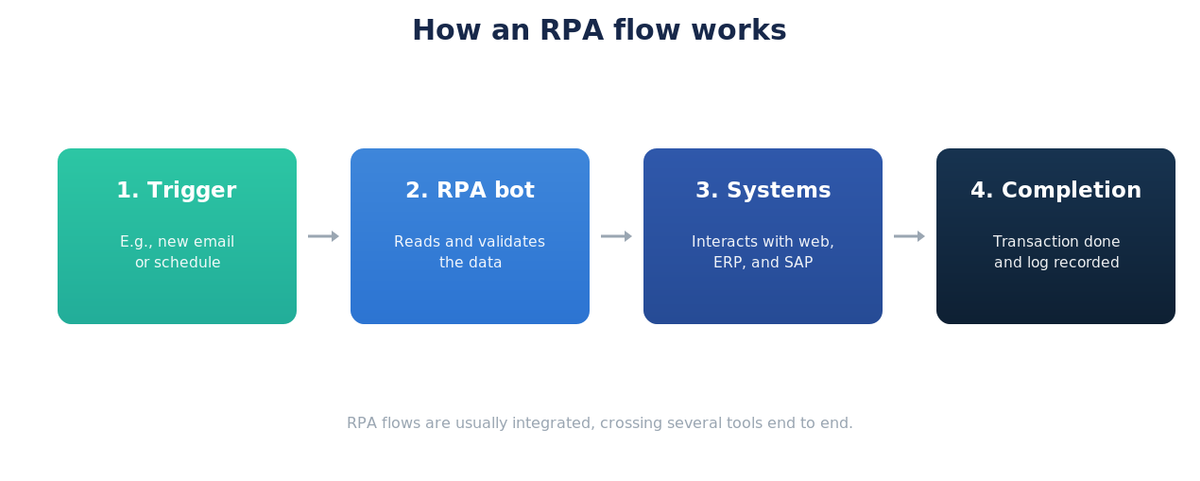
In practice, bots commonly operate in integrated flows. A process may start with an email trigger, lead the robot to interact with a web system, and end in a transaction in SAP. These integrated flows, which cross several tools, are frequent in RPA projects.
Benefits of RPA for your company
Increased efficiency
By taking on recurring tasks, bots do the work much faster than a person and free the team for higher-value activities that require critical thinking, creativity, or strategic vision. The result is more productivity, since employees no longer interrupt their work to run monotonous processes.
Cost reduction
Automation generates relevant savings: it reduces the need for labor in routine tasks and gives teams back the time they used to spend on them. Since bots work 24 hours a day, 7 days a week, operational efficiency grows even more.
More precision
Because they follow predefined rules, bots keep a very low error rate, which reduces rework. People can fail in moments of fatigue or distraction; machines, properly configured, always keep the same consistency.
Compliance and security
Bots operate according to the established rules and record every action in logs, which makes audits easier and helps ensure compliance with regulations. In addition, they follow security protocols that help protect sensitive data.
Scalability
RPA solutions scale easily to keep up with increases in workload. Need twice as many reports? New bots can be put to work in a few clicks, without the need to hire and train new people.
Integration between systems
RPA connects tools that normally do not talk to each other, orchestrating tasks that go through email, web systems, and ERPs in a single automated flow.
RPA in numbers
The gains also show up in the market numbers. According to Gartner, RPA shows consistent strength and growth:
- Global RPA software revenue projected at US$ 1.89 billion in 2021, a 19.5% increase over 2020.
- Forecast that 90% of large organizations would adopt some type of RPA by 2022.
- Market projected to grow at double-digit rates in the following years.
- Estimate that, by 2024, large organizations would triple the capacity of their RPA portfolios.
Source: Gartner, "Worldwide Robotic Process Automation Software Revenue to Reach Nearly $2 Billion in 2021" (September 2020).
RPA application examples
Financial sector
In finance, RPA automates processes such as account reconciliation, invoice processing, and report generation. The effect is more efficiency and less risk of error in critical activities.
Human resources
In HR, the technology automates resume screening, onboarding of new employees, and payroll management. As a result, the team focuses on strategic activities such as talent development, performance management, and engagement.
Customer service
In customer service, RPA answers frequent questions, processes orders, and manages returns. The result is faster and more efficient support, which raises perceived quality and customer satisfaction.
Challenges and precautions when adopting RPA
Despite the benefits, RPA is not a magic solution. To avoid frustration, some precautions are essential:
- Do not automate a bad process: before automating, it is worth reviewing and optimizing the flow, or you will just speed up a problem.
- Highly unstable processes or ones whose rules change frequently deliver little return and require constant maintenance.
- Changes in system interfaces can break bots, which reinforces the importance of development standards and monitoring.
- Governance and security need to be defined from the start, with control of the robots' access and credentials.
How to implement RPA in your company
A successful adoption usually follows five stages:
1. Process identification
Map the processes that meet the basic requirements for RPA: repetitive, rule-based tasks that consume a lot of time. At Atomic, we follow the concept of "Think Big, but Start Small": we begin with small processes that create bottlenecks and bring a quick return, always with development standards that ensure maintenance and reuse of the features.
2. Choosing the RPA tool
There are several tools on the market, such as UiPath and Automation Anywhere. Carefully analyze which one best meets your business needs and ensure you have qualified professionals for development. At Atomic, besides a team specialized in these tools, we have Proton, our automation platform that speeds up the creation and management of bots, combined with experience in projects and automation best practices.
3. Planning and pilot
Create a development and implementation plan and run a pilot project to validate the effectiveness of the solution. Start with an MVP, which Atomic can help build free of charge, to show concrete results to the business areas and other stakeholders.
4. Scalability
With the pilot validated, plan the expansion to other processes and departments. From our experience, new demands arise naturally as other areas realize the potential of automating burdensome tasks.
5. Monitoring and optimization
Track the bots' performance and collaborate with the areas to identify flows that use similar processes, allowing you to reuse robots already developed. Make adjustments and maintenance whenever necessary. If you still have doubts about whether it is time to automate, it is worth checking the signs that your company needs to automate tasks.
Conclusion
Robotic Process Automation is a powerful technology to transform the way your company operates. By automating repetitive, rule-based tasks, RPA increases efficiency, reduces costs, and improves process accuracy, delivering major performance gains at low operational cost. Well implemented, it becomes a pillar of the business's digital maturity.
Interested? Atomic Solutions has 10 years in the market applying RPA for clients in various sectors, with proprietary technology through Proton. Get in touch with Atomic and request a customized application for your company.
